Wednesday, July 18, 2012

ESSAYS ENCAPSULATING JULY

CASE STUDIES
Our instructor training had been thorough, but certain situations came up that our employers had never anticipated. What happens when your student refuses to drink water because her basketball coach told her that hydration is for the weak? What if your chaperone gets so constipated that she has to be evacuated to the ER over an hour's drive away? What if one girl gets blistering rashes from an allergy to sunlight -while you are encamped in a shadeless valley of sagebrush? What if your smallest camper breaks her finger playing tag and then faints in your arms? The crises came thick and fast. As a group, the kids still seemed to be having a blast, but every night Joshua, Nicole and I sat in the Suburban filling out the daily log and wondering what the hell was going to happen next. Back in April, my Wilderness First Responder instructor had told his class that after he became certified as a WFR (one certification down from an EMT), people had, remarkably, started to collapse all over the place right in front of him, and that it would probably happen to us too. At the time I'd thought he was joking...
After seven days of aggressive intervention and encouragement on our part (“Would you run a car on an empty tank? No? Then why won't you drink water?) Joshua and I spotted the teetotaler sipping from her bottle without being ordered to do so. Yes! We exchanged subtle high fives. Hopefully she'd go back to California now and tell her coach where to stick his (empty) water bottle. We salved and bandaged the blistered hands of the girl with the allergy, and took the last girl to the clinic for xrays and a splint.
The chaperone, for her part, recovered with the aid of enema.
These misfortunes all went down on our first course together. At the end of the trip, we took a certain satisfaction in telling Andy, the nursing student from the other team, about all the medical crises we had handled.
“I heard they gave her an enema?” he said. His eyes were wide with excitement. “Really? Did you get to watch? And a broken finger. Woowwww!”
Alas, poor EMT, the worst incident on his trip was menstrual cramps. Undaunted, he had filled out a SOAP note (medical procedure sheet) and took a series of vitals. All normal, I presume.
But our team would have been happy without the drama. So many incident reports to fill out! No wonder our post-course debrief back in Missoula took six hours. Fortunately, our boss had nothing but praise for the way we had handled things.
The next trip that we took out consisted of students from Montana, Wyoming, and Idaho. There were no chaperones, which was honestly a relief, and all of the kids had used an outhouse before. They were definitely a hardier bunch than the Oakland, CA private-school kids, and there were no medical issues save bug bites and blisters. Lacking the schoolside living laboratory of the Oakland group, however, their ecological knowledge coming into the course was a little spottier. On the pre-course questionnaire, one student listed Ecology Project International as one of the federal agencies controlling land in Yellowstone. Another listed 'hypotenuse' as the first step in the Scientific Method. The shortest path to the conclusion? I wondered, reading over the assessments later. Several expressed the attitude that wolves were killing all the game in Idaho and ought to be shot. The ranger Rick McIntyre, with his wolf soap opera stories and his baby photos of superwolf #21, changed some of their minds, but not all: the most stubborn holdout wrote on her post-course assessment, “WOLVES ARE AWESOME. BUT I STILL HATE THEM.”
I did not know how to answer that. 


WILD ANIMALS I HAVE KNOWN
It was Nicole's life ambition to see a wolverine, so naturally we teased her all the time about it.
Waiting until her back was turned - “What was that – up on the avalanche slope?” “Yeah I saw it too. Definitely a wolverine. I think it might have been riding a unicycle...”
Visiting a wolverine trap built by the Forest Service was a reasonable substitute. Trapping is conducted only in winter, when the bears are a-bed; the wolverines are radio-collared and then released to their wanderings. Their territories encompass hundreds of square miles, and some of them have been caught scaling thousands of vertical feet over mountain faces in the snow, apparently for the sheer hell of it. The traps are hinged boxes built of enormous  logs, but a wolverine left trapped for more than 12 hours will usually manage to chew itself free. Fierce fantastic animals, no wonder she loved them.
We never did spot one, but other mustelids made up for it. The other team photographed two long-tailed weasels popping their heads out of a mountain bluebird box, and on the first course, our group spotted a badger hunting ground squirrels in the grass near a ranger station. It dived in and out of the ground, kicking up sprays of dirt with all four paws. One of the chaperones drifted closer to take photographs and all the kids followed, breaking the respectful distance we were trying to maintain.
“They're all over on my in-laws' bison ranch,” Joshua said. “Very aggressive. This one time one chased my wife across a field -” At that moment the badger noticed the students. Its ears came forward and it began to shamble towards us, faster and faster. The eye contact was bright and direct; there was no fear there. It had been hunting in a little draw below, and as it came closer it disappeared on the slope, only to reappear over the lip, charging us. The whole line of students stepped back as one. At the last moment, the animal sheered off and made for the hills.
That was the wolf-watching day, and we saw several wolves as well, but I think the badger left the most lasting impression. To round it out, otters turned up on almost every trip to Trout Lake. They too were a hit, especially once the cutthroat spawning run began and the adults started teaching the kits how to fish. One kit had paralyzed hind legs; it could swim fairly well, but couldn't travel on land. It didn't seem destined for a long life, and I wondered if we would continue to see it through the summer.
Pronghorn, elk, and bison were everywhere. Funny how something so large so quickly becomes part of the backdrop. “What was that up on the hill?” someone would say. “Oh, it was just a bison...”
The elk cows led their calves into the town of Mammoth Hot Springs and lay on the lawns in the shade. Everywhere they bedded down, a ranger followed with a barricade to separate them from the crowds of tourists.
In contrast to my experiences in Glacier, the bears of Yellowstone mostly manifested themselves as traffic jams. Sometimes you caught a glimpse of the bear as you wove through the stalled cars, mostly you just saw hordes of people standing on the roadside clutching cameras and absurdly huge spotting scopes. I would have much preferred to see a great gray owl, but unfortunately all the hot tips we got from rangers about recent sightings involved remote corners of the park where our student-centered itinerary would never take us...


ALL IMAGES COURTESY OF NICOLE HARKNESS AND ERIN CLARK (c) 2012
To see the rest of the album go to  http://www.flickr.com/photos/82778186@N07/
 

Tuesday, June 12, 2012

Yellowstone 2012 - Instructor Training

We were sitting against a fallen Douglas-fir on the edge of a mountain lake, and Joshua was talking about orienteering.
“So after you've adjusted the compass to account for angle of declination—whoa, a chocolate lily!”
His face lit up with happiness as he bent towards the little speckled flowers.
“That is so cool. Yeah, anyway...sorry, what was I saying?
There were eight of us sitting against the tree that day: six fledgling course instructors and our two leaders. We were in the middle of a crash course covering the Greater Yellowstone Ecosystem and the logistics of steering 15 high school students through it on a nine day ecology research expedition. Round trip we would cover nearly a thousand miles, from Missoula to Bozeman and on into Yellowstone, from the remote Centennial and Lamar Valleys to Norris Geyser Basin. Our students would assist the Fish and Wildlife Service on mountain bluebird nest research, track wolves with the Park Service biologists, and help the US Geological Survey gather data for snowshoe hare and whitebark pine research. They would learn to cook over a Coleman and crap in the woods. They would go whitewater rafting on the Yellowstone River and hike in bear country. They would sit around the campfire and not shower. They would take formal ecology classes sitting lakeside in the long grass.
 First, though, the guides had to learn these things ourselves. Hence the crash course.
We left headquarters in Missoula early on a Monday morning, crammed into a mint-green Suburban dubbed Mama Bear. It was a glorious morning with blue skies rising and the sun just gilding the tops of the Bitteroots. Nicole and Joshua pressed their faces against the windows and car-birded, arguing happily about esoterics of field identification, a challenging practice when the bird in question is already 3 miles down the road before you can dig out your guide.
“I bet that was a yellow-headed blackbird.”
“No it wasn't, you didn't see it – it was way too orange on the breast...”
Then we passed several golden eagles sitting on a carcass roadside. There was no doubt about the identity of those bad guys. That sighting – my first – would have been crown enough for any day, and we weren't even in the park yet.Late in the afternoon we entered the Centennial Valley, west of Yellowstone. Sixty miles of rough road from the nearest city, it was broad and grassy, the hills running up to snow-topped mountains and down to marshes. Pronghorns bounded away through stands of basin rye grass. Meg, the Minnesota girl, giggled at her first glimpse of their flashing white rumps.
“Pronghorn butts,” she sang, “drive me nuts...”
Eventually we came to the headquarters of the Nature Conservancy, where our students would be helping clear undergrowth for controlled burns. After a barbeque with NC staff, we pitched camp in a field by a spring-fed stream.
When I woke up at 3 AM, the moon was bright on the prairie and the mountains glowed all around. Early in the dawn, Hannah heard a wolf howling over the hills.
As in Glacier years before, I felt like an ache the loveliness of this place I had come to.
The fine weather held through the next afternoon as we crossed into Yellowstone, but a chill wind was picking up, and I shivered as we sat among the glacier lilies at Red Rock Pass, listening to a lecture on mountain bluebird ecology. We had a whole series of assigned lessons to teach the students; part of instructor training was to practice teaching the curriculum. One of my lessons was on grizzly bear safety, but there was geography, geology, risk management, and a whole host of other subjects besides.

By the time we crossed into Yellowstone itself late that evening, the temperature had dropped to 30 degrees and the sunset was dimmed in darkening clouds. So it was with some dismay that we realized that Slough Creek, our planned campground, was closed. We piled back into Mama Bear and continued through the park. Snow began to fall. Nicole, the intern,was driving. The Suburban and trailer swayed in the gusts. As we rounded hairpin turns, the headlights illuminated snowbanks and steep drops into the canyon below.
At 10:30 PM we came to Canyon Campground and pitched our tents. All night long I snuggled in my bag, half-aware of the sleet pounding the fly of my sturdy little tent.
Next day, hot drinks all around and a silly game where we hopped around in the fresh snow pretending to be penguins. You are never too old for silly games; we played them constantly, two or three times a day.
Then on to Norris Geyser Basin, an eerie simmering landscape of steam vents and mud pots. We wandered around discussing Solfolobus vs Thermophilia aquatica, watching the pools boil, and crooning over a bright patch of bog laurel on the edge of the boardwalk.

Timber Camp, high in the national forest above Gardiner, MT, wasn't much warmer, but at least there was no snow as we set up camp. We were prepping for an early day ahead: wolf-watching with NPS ranger Rick McIntyre, a 6 AM rendezvous in the Lamar Valley.
Dawn next morning found us on the road. Deep into the park, past the bison herd sleeping in the sage, we spotted McIntyre's neon-yellow Nissan X-terra, bristling with telemetry equipment. It was early enough that most of his fans, a hard-core group of amateur wolf-watchers in Subarus, had yet to show up. A little DeHavilland bush plane buzzed around overhead. In it was Doug Smith, Yellowstone's head wolf biologist. He had picked up a signal from one of the alpha wolves of the Lamar Canyon pack.
We stood around awhile, scanning with binoculars (or in McIntyre's case a Swarovski crystal spotting scope), until a bunch of tourists in a Yellowstone Association bus pulled up to see what we were looking at.
“Let's shake em off!” McIntyre hissed, and leapt into his X-terra to charge away, following a new lead. We caught up with him again as he scrambled up a hill above the Lamar River with a grand view over rolling hills and meadows toward the high mountains. Telemetry told us the wolves were out there, somewhere, moving over that vast landscape – but where? Ducking into trees? Moving low through a drainage back towards the den?
As we scanned, McIntyre told us stories of the Lamar wolve, garnered from sixteen years of day-in day-out experience. He was an excellent storyteller and the stories were virtually Old Testament in their drama and scope.
“Now, 21 was the biggest, strongest wolf ever to come into this valley. When members of Mollie's Pack came raiding, he could stand in battle against six of them alone, twice the number of any other wolf...His son-in-law, 480, had none of 21's strength but he was far more cunning. When 21 finally died of old age. 480 become alpha. This is the story of how 480 went alone to lead the members of the Mollie's Pack into an ambush and save the lives of his five young pups...”
“I see one!” a woman cried. McIntyre broke off to come over and look, only to deem it a pronghorn. Disappointment all around.
We finally forsook the McIntyre brigade and headed to the Trout Lake trailhead for a hike.
We were gathering our gear when Andy, the 20-year old Wilderness EMT, saw a woman vomiting and convulsing on the side of the parking lot. He immediately snapped into action. The rest of us maintained a polite distance as Andy and Joshua went over to offer assistance. The woman's husband looked up in grateful disbelief and said, “I'm so glad you're here.”
I won't discuss the details, but her condition was severe enough to merit an ambulance. No one had cell service, so leader Josh (not to be confused with Joshua) drove off in search of Rick McIntyre and his radios. Meanwhile, Andy pulled a stethoscope and blood pressure cuff from his backpack and monitored the woman's vitals as Joshua assisted. Andy's calm professionalism was obvious even from a distance. Both husband and wife seemed relaxed and engaged, despite her distress. Joshua told me later that they were field biologists and had cheerfully talked birds with him while they waited for the ambulance. It took a long time, almost an hour, for the paramedics to show up – and this on a main park road in June! Our Wilderness First Responder training was no joke in this setting, especially with students.
After the ambulance came, we hiked up to Trout Lake, nestled all lovely among the cliffs. An otter munched a trout on a log as as we walked around the shore; other trout drifted in the shadows; an osprey soared overhead. We settled down in the shade of the Douglas-fir to eat lunch. The rescuers were still shaken from their heroics. We debriefed the incident as a group until they felt ready to move on to the scheduled orienteering lesson.
I was only half-focused, I kept looking around and looking around, birds and fish and flowers, the otter in a cove now doing backflips, light winds ruffling the treetops. And I looked forward to the day when we would bring students here. This bright and violent land.


photos (c) 2012 Megan Myer, Lily Vonderheide

Monday, April 23, 2012

Glacier Stories

I'm going back to Montana this summer! I've been offered a position with Ecology Project International, leading high school students on wildlife research trips in Yellowstone. Hopefully I'll have some killer new Montana stories for the blog soon, but in the meantime I've decided to post some unpublished stories from my time working as a tour guide in Glacier National Park in 2008 and 2009.

1. June


"Tell me please, where is the swift current?"

He was really worried about it. So was his wife; they pushed up close, blocking my path down the dock.
"Well you know, Swiftcurrent is kind of a misnomer," I said. "This is a lake."
Looking over their shoulder, I saw that the green rowboat was taking on more water. It was up to the gunwales by now.
"What? But the tour, where does it go --"
James was down by the water already, reaching for the rowboat. He motioned, get over here.  I had been on my way to help him when I was ambushed by these bewildered Japanese tourists.
 "Listen, I'll explain later," I said, and ran.
Together we heaved the boat up onto dock. James raised an eyebrow at me.
"You know, that stern plug was right out on the seat. And there's no spare."
We contemplated the weedy lakefloor, ten feet down, where the rubber plug had vanished.
"I guess that means I'm going after it," I said.
It really was my fault. Nick had left all the plugs out after draining the boats, but I was the one who'd pushed the thing in. Diving though-- what an ugly prospect. Early July on Swiftcurrent Lake meant glacial meltwater, fifty degrees or less.
The plug was still somewhere under the dock when I finished work at six thirty. I went home to the cabin to get a towel and recruit moral support. Remarkably, Anne and Ali were game, so we rowed back down the lake together, three captains on a mission.
Ali took off her funky sunglasses, sat down on the edge and stuck a toe in.
"Oh shit. This is going to hurt."
None of us wanted to get in until we could actually spot the plug, but the shadows were lengthening and the weeds down there were pretty thick. Finally Anne, in her practical way, simply jumped, and Ali and I followed suit. We touched bottom and rocketed right back up again, flopping onto the dock like seals.
My whole body had seized up; I was strangely short of breath. I lunged for my towel, swearing.
"There is no way I'm doing that again," Ali said.
"Well, we tried," Anne said. "James will see that at least we got our hair wet."
Still dripping, the three of us retired to the hotel lounge and split a bottle of huckleberry wine.
No one ever did find that plug.  The rowboat sat out, unrented, for a while, and in the end we had to borrow a new plug from another dock.

ii.   

James, Ali, Anne and I -- and also Nick, Dave, Mara, and Amanda -- were, respectively, the manager and captains of the Glacier Park Boat Company, Many Glacier dock. With the exception of Nick, who lived in a shack at his parents' campground, we all shared a cabin on a cove up Swiftcurrent from the Many Glacier Hotel. Every morning we took the forty-six foot tour boat, Chief Two Guns, down to run tours all day, catering to the hotel guests and the daytrippers, the hikers and the grandmas and the crazies. Every night we came back to the cabin on the shore. The cabin had only recently been outfitted with non-generator electric; the refrigerator ran on propane and we didn't have a phone line. So those who had instruments played them while other people fixed dinner or went out rowing in the green evening shadows. Moose and beaver swam past the living room windows, loons called in the distance, and the days were long, the light holding through eleven o'clock on a clear night.
I don't mean to make this out like we sat around all the time singing 'Kumbya,' but compared to my last job, a stint on the line in a lightbulb factory, Glacier Park was damn close to paradise. Even when things got ugly, like they do sometimes, you were still standing in a high clean country, and the mountains reflected in the lake etched against the sky were so beautiful they gave you a kind of ache…
For the first time, my friends back home envied me my job -- how do you get a sweet job like that­, they wanted to know, as opposed to the usual oh my God, I'm sorry -- when I shared my summer plans. I told them the truth:  the previous August, staring at the one hundred millionth lightbulb socket rolling down the belt, I had gotten a lucky feeling about Montana. It came out of nowhere and it wouldn't leave me alone. So I did what any smart person would do: I got on the Internet. Google led me to the Boat Company, and they hired me in February.  Sleet hammered against the windows of my Chicago apartment the day I got the call - slush piled ankle-deep on the sidewalk - summer was purely theoretical. But I watched the trains roll through and held onto the day that I would turn to the West. It wasn't running away, not exactly, but winter and the factory had left a mark on me like a waterstain, and I was tired all under my skin. It was time to leave.
When I got off the train in Montana, Chicago melted into a slab of glass and concrete and retreated to the back of my head. For a while I left it there.
My first view of the park was Rising Wolf Mountain under the moon and beneath its bulk, Two Medicine Lake, a mirror of every star in the sky. I fell asleep in a house by the shore, and so began a strange lovely summer in the shadow of the Rockies by the green running water.
                                                                
iii.   
Having cast up in Glacier early Sunday, I started work first thing the next morning. It had been a heady twenty-four hours - East Glacier Amtrak station, Two Medicine boat dock where I spent the night, meeting my new boss James, the drive across open country to Many Glacier in the wall of western mountains, the cabin at the end of the road, and a slew of roommates whose names all seemed to start with 'A'…
Now it was Monday and I stepped aboard Chief Two Guns for the first time, wearing a blue shirt that proclaimed me a member of 'Montana's Mountain Navy.' Two Guns was beautiful, a blue and white wooden boat with a flat roof and a shallow draft and eighteen rows of wooden benches.
"Welcome aboard," said Dave, the assistant manager, a sweetfaced kid in a baseball cap. "First thing every morning, we take care of the boat, fuel, check the fluids, and so on."
While Anne and Mara mopped and washed the windows, Dave showed me how to lift the central row of benches, exposing the diesel engine coiled under the floor like a mass of monstrous steel blue intestines. The fluid levels and the bilge had to be recorded in a log book that was greasy and dogeared from previous seasons. I followed Dave up and down the deck like a puppy, watching as he explained various details.
At last he turned on the boat. Mara untied the stern line as the engine roared to life.
Dave took us away from the home dock and steered for the other side of the lake, where a trail ran out from another dock into deep woods. The water was emerald green and rocks lined the shore so precisely that they looked landscaped, but beyond the dock and the trail lay a tangle of conifer forest that climbed up and up before bursting into daylight as the scree-marked face of Mt. Allen.
Anne jumped out carrying two yellow fuel cans and disappeared into the trees.
"She'll go across to Lake Josephine and get Morning Eagle ready for tours," Dave said. "We'll go over there later."
Meanwhile he backed out and peeled away down Swiftcurrent, passing the cabin, navigating a narrow shallow stretch, passing a marsh and a beaver dam, passing all the mountains whose names and histories I would come to learn so thoroughly that I gave tours in my dreams, and finally rounding across in front of the big waterfront hotel to dock.
"This is the most difficult dock," Dave said, "but the wind only blows one way here, so at least you know where you're at."
He steered bow-first for the broadside of the dock, at the last minute veering slightly right so that our port side just lightly bumped against the last piling. Mara caught our bowline, and Dave put the throttle back in forward so the stern swung around and lay flush with the dock.
"Did you catch that?"
No, no I hadn't. It would be at least three days before I tackled the hotel dock, and much longer before I mastered it.
Passengers for the first tour were already milling around in front of the ticket office, a tiny hut in the hotel's shadow.
"Call them in," Dave said, so I stepped up and shouted "All abooooaaaard!" like an old-timey rail conductor. They shuffled along the gangway and descended the stairs into the bow. My first tourists! I was thrilled.
Last to come on was a Park Service ranger in a green uniform. The 9 AM tours, I learned, were always led by rangers; they gave the commentary and led a hike from the other side of Lake Josephine.
Dave got on the mike, went over safety procedures, and then handed it over to Ranger Kara, who began the tour as soon as we were cast us off. I sat in the front seat, trying to keep track of it all. Kara talked about the hotel, the landmarks around the lake, the bears and the bighorn sheep, history here, geology there, and so on.
(Boat Co tours were essentially identical to ranger tours, except that we had much more leeway to make silly jokes. For some reason the Park Service frowned on their rangers answering the question 'What happens if we see a grizzly bear?' with "Well, first of all you should make a tight circle around me…")
Dave docked at the head of the lake where we'd left Anne. He let everyone off and they headed down the trail, presumably to the next lake.
"Now the nice thing to do is radio the other boat when you send them over."
He spoke into the radio receiver.
"Two Guns to Morning Eagle, they're headed over the hill."
"Copy that," Anne crackled back.
He hung up the receiver. "Now are you ready to practice?"
Hands shaking a little, I took the wheel.
Well, steering those boats was dead-easy. You turned the wheel and where the bow went, the boat went. As long as you didn't run out of lake, you were golden.
Docking was another story again. It required a lot of maneuvering and throttling, forward idle, reverse, neutral, forward again, and just to make things kicky, the wind at the head of the lake habitually blew in circles. The problem was that I had no idea what fifty feet of boat did when you turned the wheel or gave it throttle, when the wind blew or the waves picked up. After I got a feel for these things it all made more sense, and I gradually lost the conviction that the boat was going to defy my captainship and the laws of physics by leaping forward to grind against the shore. But docking made for a steep learning curve.
When Anne volleyed the 9 AM tour back at us, Dave called a halt.
"We'll take this group back to the hotel and go work on Morning Eagle after lunch."
True to this promise, afternoon found us walking over the hill to Morning Eagle. From Swiftcurrent, you would never guess at the existence of Lake Josephine, surrounded by mountains on three sides and stretching two miles up the valley toward the high columns of the Garden Wall. Josephine was even more beautiful than Swiftcurrent, but I lost track of the scenery as I struggled to master Morning Eagle, a faster and touchier boat with an outboard propeller that made the steering work opposite to Two Guns'.
At last I managed to bring her home without too much panic, and then I did it again. Dave threw the bowline, securing us to dock.
"Good. That was good. Once you have two in a row, it's time to take a break."
We tied the stern line and killed the engine, and then he put his hands on the roof and vaulted up.
"The afternoon on Josey is the best part. You can take a nap between tours…We'll practice more before the 4:30 comes over."
As he stretched himself out in the sun, I lay down on the dock and looked into the water. Six feet deep, and clearer than the water out of my faucet in Chicago. A galaxy of colored pebbles lined the bottom - blood red, emerald, black, pink, and brindle-striped in gray and green. I dipped my hand in and pulled it right back out, already numb. Farther out, beyond the dropoff, the lake swallowed the sunlight and turned deep aquamarine, an effect born of the glacial flour suspended in the water column. Up at the head of the valley, high on the wall, lay the three glaciers themselves.
It was like some wild miracle that I had landed in this place, that a place like this existed, and that was something I never got used to; on the last day as much as the first it got to me, the sheer and furious and pristine beauty, the aliveness of that landscape among the mountains still covered with snow.
The second afternoon of my apprenticeship found me back on Morning Eagle, this time with James and Amanda, also a new captain. I was a little nervous to learn with James; Dave was the sweetest kid in the world, but James struck me as altogether sharper and less easy-going.
For her part, Amanda was a Midwesterner turned mountain hippy: she had dreadlocks and big earrings, and hardly ever washed her pants. 
James had us take turns docking. Amanda had had a few weeks' practice on me, and nailed her landings every time, while I more or less flailed around. James didn't say much, but he had a way of standing there staring at you while not saying it that was slightly disconcerting.
When the 4:30 tour came over the hill, he jumped off the boat and gave Amanda a look that made the light glint off his glasses, turning his eyes into twin silver plates.
"Why don't you solo this one? Lily can ride along and throw your lines."
It would be her first solo. As I would learn for myself, James made a habit of not telling new captains when their turn was coming up.
Amanda was a little taken aback, but excited too, and once we got everyone boarded and out on the water, she launched confidently into the Josephine tour, a kind of sequel to the one on Swiftcurrent, touching on bears, glaciers, geology, and the history of the park and the Boat Company. I perched on the stairs with the breeze in my face, taking mental notes.
The dock at the head of the lake came into view. I stood up, ready to throw the bowline. We were still roaring along at tour speed.
One beat, two beats, we were thirty feet away now, and you didn't need Coast Guard certification to realize we should be slowing down. I sneaked a glance at Amanda. She looked terrified. Oh hell, the stage fright had gotten to her. And it had been going so nicely.
 Next moment, we plowed into the dock, all twelve tons of boat and tourists. Boards flew everywhere.
"FUCK!" Amanda shrieked, and killed the engine.
 In the sudden silence, we dusted ourselves off and looked around. The dock had sprung a gaping hole and bits of it were floating off in the direction of Cataract Creek. The passengers began to mutter, an embarrassed mutter undercut by panic.
"What was that - " I started, but Amanda cut me off.
"There's something wrong with the throttle! It wouldn't go into reverse! Oh my God, I tried to ease it down and it just kept going - "
She snatched the radio.
"Morning Eagle to James? Morning Eagle to James!"
James' voice crackled back over the intercom. Meanwhile, I had another problem to work on. The dock pilings were still sound, so I had gotten our lines tied up, but the hikers who had been waiting to catch the boat now rushed down to investigate.
"Hey, what's wrong?"
"Can we get on the boat anyway?"
"Lemme through, I bet I can fix it."
The dock groaned dangerously.
"EVERYBODY OFF!" I bellowed. "GET BACK ON THE BEACH!"
I jumped over the hole and physically blocked the gangway. Slowly, reluctantly, they sidled back to dry ground.
I went back to consult with Amanda. She was a little pale, but starting to calm down.
"He says to get back on the water and they'll meet us in the chase boat."
"Okay," I said, and very slowly, very carefully, we pulled away from dock. I looked back once at the people left on shore. They made a forlorn group huddled there. A few shook their fists in apparent rage as Morning Eagle retreated.
Far down the lake I spotted James and Dave in the battered old outboard skiff that served precisely for emergencies like this. The cavalry was coming, but what were they going to do when they arrived? From the murmur of the passengers, everyone else was wondering the same thing.
They veered close under our port side, moving fast. Dave stood up, teetering, and then, in a single move, leapt up to the gunwales and swarmed in through a window, while James gunned the chase boat and roared off down the lake. Dave strolled up to the bow - Amanda handed over the wheel without a word. The audience gazed at their hijacker, thunderstruck.
"Hi everyone," he said. "I'm Dave."
And they applauded wildly.
He took Morning Eagle and beached her in the shallows off the dock, and we all helped everyone to shore. Amanda and I herded them over the hill, where Anne waited with Two Guns. 
James would ferry the hikers home in the chase boat and then, with Dave and the boat owners, spend half the night fixing the outboard on Morning Eagle.
We made it back to the hotel without incident. The passengers were still chattering about Dave and his badass pirate moves as they disembarked.  I never saw such happy customers, not before or since. They knew they'd gotten their money's worth.

Friday, September 2, 2011

Goodnight, Irene

Saturday, the 27th of August, was sunny and humid. Camp was finally over; the last guests had packed up their families and left early, heading back to Connecticut and the Cape to pull in their sailboats, shutter up their beach houses. Irene was coming. We had been watching the radar for days, but it was hard to say what, if anything, would happen when it finally came over us. As a child of the Midwest, I'd seen plenty of tornado weather, but never experienced anything like the slow, oncoming inevitability of a hurricane.
After lunch, we split into groups to start shutting things down. My team was assigned to pull up boats from the lakefront. While a team of dock specialists in wetsuits broke down the docks, we loaded the sailboats onto a trailer and drove them up the hill, to lie safely out of the wind and waves. It was hard work, but we were laughing and happy; there was a sense of camaraderie and definite purpose, unusual for Arcadia.
All through that hot afternoon, I watched the clouds rising up, big thunderheads riding out ahead of the rain. Dinner conversation that night centered on the storm. No authority figure had given any indication of emergency preparations, of where we might go if the conditions were bad. The more cynical staff members speculated that the authority just didn't care. It was all too easy to imagine them leaving us to fend for ourselves in our cabin down by the lake. After all, we'd already put away all the valuable equipment. But I preferred to believe that it wouldn't come to that.
The rain started in the night. When I woke up in the morning I looked out to see curtains of it passing over the far side of the lake, and what I thought was water streaming off the cabin roof turned out to be only the rain.
The power went out at 9 AM, killing all attempts at a productive workday. Little by little, people began filtering into the main lodge where a fire was going. We sat in the dark and played cards by the light of headlamps. The rain was still lashing down, and the trees began to bend in the wind.
The first big branch fell around lunchtime. I was sitting on the porch of the lodge when it came crashing down on the infirmary roof. Others soon joined it. Some people started a game of guessing which branch or tree would fall next, cheering for their candidate when a big gust came through. Gripped by the wind, the trees bent and groaned. It seemed that they could never hold. Finally one fell, taking out the window and a corner of roof on a cabin next to the main lodge. Then another, down in the field by another cabin, and another and another. Limbs and cones littered the ground. An enormous tree fell by the shower house, leaving a hole waist deep in the path. People screamed and rushed out to take pictures of themselves standing in it.
When the wind retreated a little, I took a stroll with some other people to look at the waterfront. Pleasant Lake, usually so murky and placid, was lashing the beach. Two ducks rode the breakers. No matter how hard they paddled, the swell threw them to the shore and back, over and over. When I looked up at the sky, the clouds were scudding by so fast they made you seasick.
Back on the porch, Jess and Will, the most senior counselors, were drinking gin-and-tonics. Very classy. Really, the ideal cocktail for sitting out a natural disaster. Will was anxious because a big triple-trunked tree, leaning directly over the porch, had begun to twist and warp in the wind. He and Jess phoned the camp directors, who were in their own cottages half a away, and received permission to move us to the big house by the road, if it came to that.
The storm howled on, and the world was violent and wild all around us. Then little by little it began to calm, and by suppertime was quite still.
When it got dark we lugged our things up to the loft of the big house for the night, safe from blow-downs and any following winds. It was like a private refugee camp up there, everyone set up on thin bunkbed mattresses, gathering to talk and play games in the light of a storm lantern.
I fell asleep early and missed the winds that came in the night. When I got up, the day was bright and the whole camp was carpeted in pine branches.

Tuesday, July 26, 2011

Expedition to Mt Washington

I was looking forward to the Washington trip, but I definitely needed some breathing room beforehand. So on my night off, after watching Harry Potter 7/2 in Scarborough (Harry Potter and the Curb Stomp Beatdown!), I drove out to a state park I know in Cape Elizabeth and slipped in to sleep on the beach in the moonlight, which was so incandescently bright that I cast a shadow on the sand. A strong wind came in over the water and the clouds were speckled with stars. When I got up in the morning, my clothes smelled like salt. I had an early breakfast on a wharf-front diner in Portland, and then drove back to pack for Washington.
Three counselors were assigned to this trip: me; a male counselor, P.; and B., my boss, the head of the trips department. On Tuesday morning, we mustered the seven teenage girls, ages 13 -16, an interesting assortment of characters, and hit the road.
It was a beautiful sunny day as we started up the trail. The Mt Washington trip is reserved for the toughest, most experienced hikers at camp, and they were happy to be in the woods again; we set a brisk pace uphill through the forest. At the edge of the alpine zone, everyone was momentarily sobered by this sign:

and I thought again about what it means to lead other people's children into the wilderness. Under the guidance of B., with her military background, the trips counselors in our department took this responsibility very, very seriously. Other camps, as we soon learned, did not. On the 2nd day of our trip we hiked 7 miles across the peaks to the summit of Washington. It was a hot day and we moved at a deliberate pace, pausing often for water breaks. The trails were crowded with other hikers. Finally we were only a mile from the top; the summit was in view. But we stopped: there was a little boy sitting on a rock beside the trail. It was the same boy we had seen earlier, stumbling and pleading for some water and 'just 5 seconds' to rest. His counselor had refused him then, and now apparently she had abandoned him on the trail to catch up later. He had no water left in his bottle. B. snapped into action. She gave the boy some water from her own emergency supply and made plans to have him hike the rest of the way with us. At that point, however, the counselor came back. She was sweaty, angry, and English.
"Don't give him more water, it's his fault he already drank all his and most of mine. Get up Leo, you have to keep going."
B. asked her what trail she was taking; the woman had no idea. She was trying to hike up the scree slope next to the cog railway. We invited her to join us on the trail, but the counselor shook her head.
"Can't. I have to go this way, I've got more kids up there somewhere." She gestured vaguely at the summit and then took off, Leo shuffling in her wake. We never saw them again. Thank God the weather was good, that we didn't experience one of Washington's notorious fogs, the kind that goes down like a curtain over a beautiful day, reducing visibility to 10 feet or less.
The summit of Washington was a surreal tourist parade. After hours of hiking through the rugged mountainscape, we climbed onto this paved plateau, with a cafeteria, a museum, and a gift shop. The summit itself was the traditional pile of rocks topped by a weathered wooden sign – but it was surrounded by the concrete observation deck, and it put me in mind of the monkey island in a zoo. People who had paid to drive up wandered around in sundresses and flipflops. I have never visited a mountain so stripped of its essential mountainness. It was an interesting experience.
There was one thing they couldn't pave down, however: the wind. Washington holds the record for one of the highest recorded surface wind speeds: 231 mph. According to Wikipedia, it blows above hurricane force approximately 110 days out of the year. In February, when I was living east of Washington in Bethel, Me, the windchill one day was approximately -72 F. The gentle zephyr blowing the day we hiked up there was nothing. Just enough to knock you off balance if you stood on the summit too long. Done with the summit, we hiked down to the slopes of Mt Monroe to stay at Lakes of the Clouds, perched on the precipice below Washington. There was a girl's camp group of 40 at Lakes, and a church group of 20, for a total of 70 or so screaming high
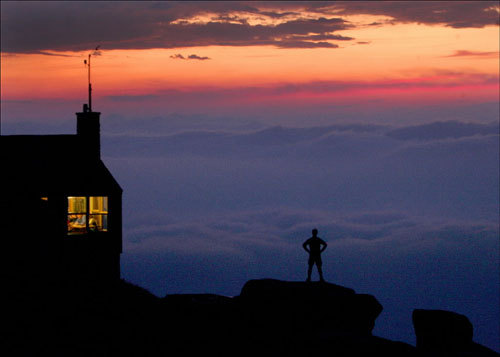
school students packed into the hut, utterly shellshocking the few legitimate adult visitors and thru-hikers trying to share the space. Our group was overwhelmed too, so we hiked up to the summit of Monroe after supper to watch the sunset, seeking peace. Up there it was cool and silent. The sun sank into banks of clouds, the mountains rolled away for miles, losing themselves in the blue haze of dusk. Directly below us the eponymous lakes nestled in the rocks reflecting the sky.

Sunday, July 17, 2011

Return to Camp: American Summer

"So they filled you in about this camper?" the nurse said. "The sleepwalking? The bedwetting? You know what to do if she gets up in the night?"
"I know," I said. "I'll be in the next bed, so I'll be able to go after her and steer her in the right direction."
"I'm worried," the older nurse interjected. "What if you don't wake up? I think you should take a string and tie one end to your wrist and the other to her arm. Just a little string, you know."
It was 9:30 PM, and I was on night duty at the camp infirmary. The three of us sat on folding chairs in the main office. A single 60-watt bulb hung over a table festooned with paperwork and jars of medicine and bandages. Down the hall I caught a glimpse of a barracks-like room lined with white-sheeted beds. It felt like a scene out of WWII. But instead of soldiers in white, my special assignment tonight was a troubled 10-year old girl. I was to sleep in the bed beside her to prevent her sleepwalking and wetting the bed. She was a sweet little kid, and I felt bad for her. But I was damned if I was going to tether myself to her, like some peasant with his only goat.
"Um, I'm a pretty light sleeper," I said. "I don't think that will be necessary."
The younger nurse gave me an ironic, sympathetic look. "Whatever you think will work. Do you want to get settled now?"
She led me into the barracks room and showed me my cot. My camper was already there, and so were two other girls, one with a fever, the other a vicious lung-rattling cough. I arranged my bed so that it blocked the sleepwalker's; she would have to climb over my bed to escape. She was awake and happy to see me, we chatted about Justin Bieber for a while, and then she went peacefully to sleep
I lay on my cot in the dark, with a little breeze at the curtains and the moonlight seeping in, and wondered, not for the first time, how how how do I end up in these jobs? Why hadn't my survival instinct kicked in that first week, when we all stood up together after supper and rearranged the dining room tables so that the wood grain in every table pointed north?
Well, it was a long night, but the sheets stayed dry. She had a beautiful sleep, much better than me or the cougher. In the morning I got up and poured coffee down my gullet and fidgeted through the traditional outdoor Sunday meeting, a non-denominational cross between Walt Whitman and a Vineyard church service. One of the nonagenarian directors told a rambling story about friendship, and also Albrecht Dürer, and then treated us to a sermon on happiness: "What is Happiness? It is a spring flower. A campfire with friends. A beautiful feeling that brings a smile to God's face." Yup, good old God, up there beaming away. And when Jesus laughs, he laughs kittens.
Finally, after the meeting my day off started, and I fled. Fleeing from camp here is simpler than it was in Russia, because I have a car. With exactly one 24 hour period off a week, though, it's hard to get very far. Fortunately, Portland and the ocean are only 45 minutes away. The boyfriend, unfortunately, is 3 hours away; I've had some lovely 5 AM drives back across the mountains, heavily caffeinated and pedal to the medal before the clock strikes duty time and I turn back into Cinderella.
Things are stressful only when I'm scheduled to work in camp, though. Most days of the week, I have a very cool job: I lead selected girls on hikes and camping trips in the wilderness. Right after breakfast, almost every day, we load up the 12-passenger van with gear and children and hit the road, radio cranked the moment we're out of the driveway. They 're not allowed to have phones, computers, or music at camp, so the radio is a treat. We have road trips, adventures, ice cream, climb mountains, pitch tents, jump off 15 foot cliffs into deep blue swimming holes, and life is good. I have now hiked and camped and driven all over the White Mountains. Next week I'm leading a trip up Mt. Washington. We'll hike for three days and stay in huts along the Appalachian Trail where lovely AMC croo members will cook lovely food for us. If you're imaging my group squatting in some kind of dismal coop, let me disabuse you. This is Lakes of the Clouds, where we'll stay the 2nd night on Washington.
Needless to say, I like this aspect of my job very much. Once again I being paid to hike. The absurdity is free.

Monday, July 5, 2010

English Day

It was an awful struggle to leave Lindsay's peaceful, wi-fi equipped flat and drag myself through the downpour to Kievsky Station, there to catch the Sunday night electric train for the 2 hour journey back to Dubravushka.
Back at camp, I started planning seriously for English Day – which meant making some copies of the lyrics to 'We Will Rock You' and taking my laptop with the music to class, and then encouraging my students to pound on their desks until the Russian teachers stuck their heads in to see what was up.
On Monday afternoon, in between classes, I was treated to the gut-punch irony of curling up for a 15 minute nap - just the briefest, blessedest respite from hours upon hours of yelling children – only to have 25 of them suddenly descend upon the piano outside my door, banging amusically and howling. Then two of them pulled open my door (which I stupidly hadn't locked) and discovered me lying on my couch under the chalkboard.
"Look, it's Leely!"
"SHUT THE DOOR!" I screamed in Russian, and they withdrew.
But the other 23 had heard me, and they all started shrieking.
"LEELY LEELY LEELY!"
Oh God. I got up and locked the door and went back and pulled the pillow over my head.
I heard a teacher come back to round them up, and felt a stir of hope – maybe they were going away now? Maybe they were going to do arts and crafts or some other really soothing thing?
But no. On the count of 'Raz, dva, tre!' the teacher started playing, and the children launched into some kind of shrill Pioneer chorus, accompanied by a 7-year old soloist keyed to dog-whistle range.
The song went on and on. When they were finished, there was a pause and then –
'Again!' the teacher cried.
I had that song in my head for the next three days.
Later, some students, prompted by their instructor, actually asked my permission before playing in the afternoon, but since they barged into my room without knocking in order to ask, I wasn't impressed.


Finally, it was Wednesday. The usual frantic morning was enlivened by the arrival of a 3rd teacher, Andrew from Moscow. We were surprised; they had warned us to expect a Polish girl from Warsaw. So was Andrew; they hadn't bothered to tell him he was coming until the day before.
At 3.30 Olga summoned me and Ariel into her office and gave us handfuls of Chupa-Chup lollipops, to be used as prizes for the English Day games. We took them and went back out to wait on a bench, but nobody came. The counselors were nowhere to be seen, no kids wandered the grounds – nothing anywhere, except the presence of me and Ariel on our park bench, suggested that an English Carnival was imminent.
Then, like a sweaty shambling teddy bear of doom, Alexander Borisovich appeared.
"Ah yes! At last! Here you are! Lily, I have your tongue -twisters, and Ari – the translations!"
He shoved fistfuls of paper at each of us.
My station was to sit and listen to students attempt to read English tongue-twisters. If I judged their pronunciation satisfactory, they got a Chupa-Chup.
"But remember!" cried AB, tapping his nose and twinkling his eye, "This game should be about fun, yes, the joy of the day, not sweets and things!"
I think he was alluding to the fact that Olga had been stingy and not given us nearly enough lollipops, so I just shrugged and went off to find my station on the porch of Bungalow Six.
At first all remained silent and peaceful. Off in the distance hordes of children had begun galloping about, but I didn't really connect them with myself until suddenly 20 teenagers stampeded onto the porch and leaned over the chair I was sitting in.
"Mozhno ya? May I?"
"No, may I first?"
"May I?"
"May I?"
I waved my arms to clear them off a little and picked a kid at random.
"You – try a tongue twister!"
I didn't recognize him from any of our classes, and the reason became evident: he didn't speak or read English.
"That was a great try," I said, and handed another twister to a second kid, who did a little better, and then to a third, the best of all. At this point, I made a strategic mistake: I reached into my teacher's satchel and took out a pineapple-mango Chupa-Chup.
"Congratulations!" I told the third student. "This is for you."
The girl's eyes lit up. She seized the lollipop, and at once the whole crowd surged in around my chair again.
"Ooooh, Chupa-Chups!"
"I want!"
"Me me me!"
They blotted out the sun; their elbows were in my eye sockets. I fought free and climbed up on a table.
"One at a time!"
When they had all had a go – two tries each – most of them wandered off, still lollipopless, except a few diehard 15 year old boys who clasped their hands and whined,
"Pleeeez….Chuuuuupa-Chups!"
"No!" I said. "Go away! No Chupa-Chups!"
Then another wave of children, and another, and another. When my 25 tiniest crowded onto the porch, I held my breath, lest even the rustle of a wrapper betray the sacred presence and spark a riot – because I didn't have 25 Chupa-Chups to hand out
Then they were gone and that, thank God, was that.

I went off to dinner – plain cold spaghetti and chopped cucumbers – and at 8 we reconvened in the hall for the skits program. Ari was already there, looking harassed as he ran his middle-schoolers through another reading of Shakespeare. I was watching Sevyeron, the skinny jugheared savant that they had translating everything into Russian, when AB swooped in and steered me into a seat at a table near the stage, which had been draped with a red-and-white English flag.
"I know, I know, you are American, you and Andrew!" he said. 'But today – ha ha! – we are all English in our hearts!"
I sat down without comment. Ariel and Andrew joined me, and shortly thereafter all the students filed in. The tiny ones spotted me and waved with hysterical enthusiasm, as if it had been 2 years instead of 2 hours since we had last met. When everyone was quiet, Olga bounded onto the stage, looking more fanatical than ever. She was still wearing the sweater vest.
"Good evening students, citizens of our beloved Dubravushka!" she screamed, to tumultuous applause. "Are You. Ready. For ENGLISH!"
Apparently they were. She retreated and the first performers, a group of girls in pink and yellow shifts, came up to do some kind of folk dance to the shrill tootling of a recorder.
At the end of this dance, they danced over to our table with a huge lump of black bread and bowl of salt.
"It is traditional,' explained Sevyeron the savant, "to welcome Russian guests with bread and salt…"
With the eyes of the whole school pinned on us, we each ripped off a chunk of bread with our bare hands and dunked it in the salt, then tried not to choke on the resultant saline frosting.
After this little ceremony, the primary schoolers came forward with a crown of oak leaves.
"This is for you, Leely!" said Sasha, their spokeswoman. "Because you are our queen!"
I bent and let them put the leafy crown on my head, then all the kids applauded and 10 or 12 of them rushed forward to hug me before their hatchet-faced Russian counselors hustled them back into their seats.
The show continued. A group of boys pantomimed a traditional Russian market day, complete with a flute playing, fights, juggling, and an openly rigged shell game. Sevyeron sang a little folk ditty that had been translated and considerably bowdlerized for the occasion. At the end of this skit we teachers were presented with a plate of blini and a bowl of sour cream. I nibbled at a blin, but soon had to desist, feeling the longing eyes of children at my back. They'd only had cold spaghetti too…
Finally it was time for what Olga had billed as our 'English Surprise."
We went onstage and summoned all our students to join us. The first strains of Queen, 'We Will Rock You,' began to thud in the background. My students, God help them, were all watching to take their dance cues from me, so I clapped and stamped my feet, and dragged them into it, until we were all clapping and stamping together – except my oak crown kept slipping my eyes. No matter.
At the end I herded them offstage with many cheers of congratulation and attempted high-fives. I say attempted because hardly any of them recognized the gesture: they got confused and we ended up gravely shaking hands instead.
Then it was time for Ariel's Shakespeare production, all but incomprehensible because half had forgotten their lines and the rest couldn't pronounce the words.
"Oh Yuliet, Yuliet…"
"Forget the fazzer and forsek thu nem…"
But Sevyeron's translation at least got big laughs, as did the bawdy little joke of holding up a discreet sheet for the newlywed Romeo and Juliet to duck behind, following the wedding scene. Olga was the only one who wasn't amused. The next day she would scold Ariel for allowing off-color elements into the production (off color? Shakespeare? Never!)…but that was all later. For the moment, all was triumphant. The curtain fell to rousing applause, and English Day was over. For another two weeks at least.